
Branding & Business Growth
Your Logo Is Not Your Brand: 9 Things South African SMEs Need to Build a Brand People Trust
A logo is only one part of your brand. Discover the 9 elements South African SMEs need to build credibility, consistency and customer trust.
By David Gous · Published 1 September 2026 · 14 min read
In short
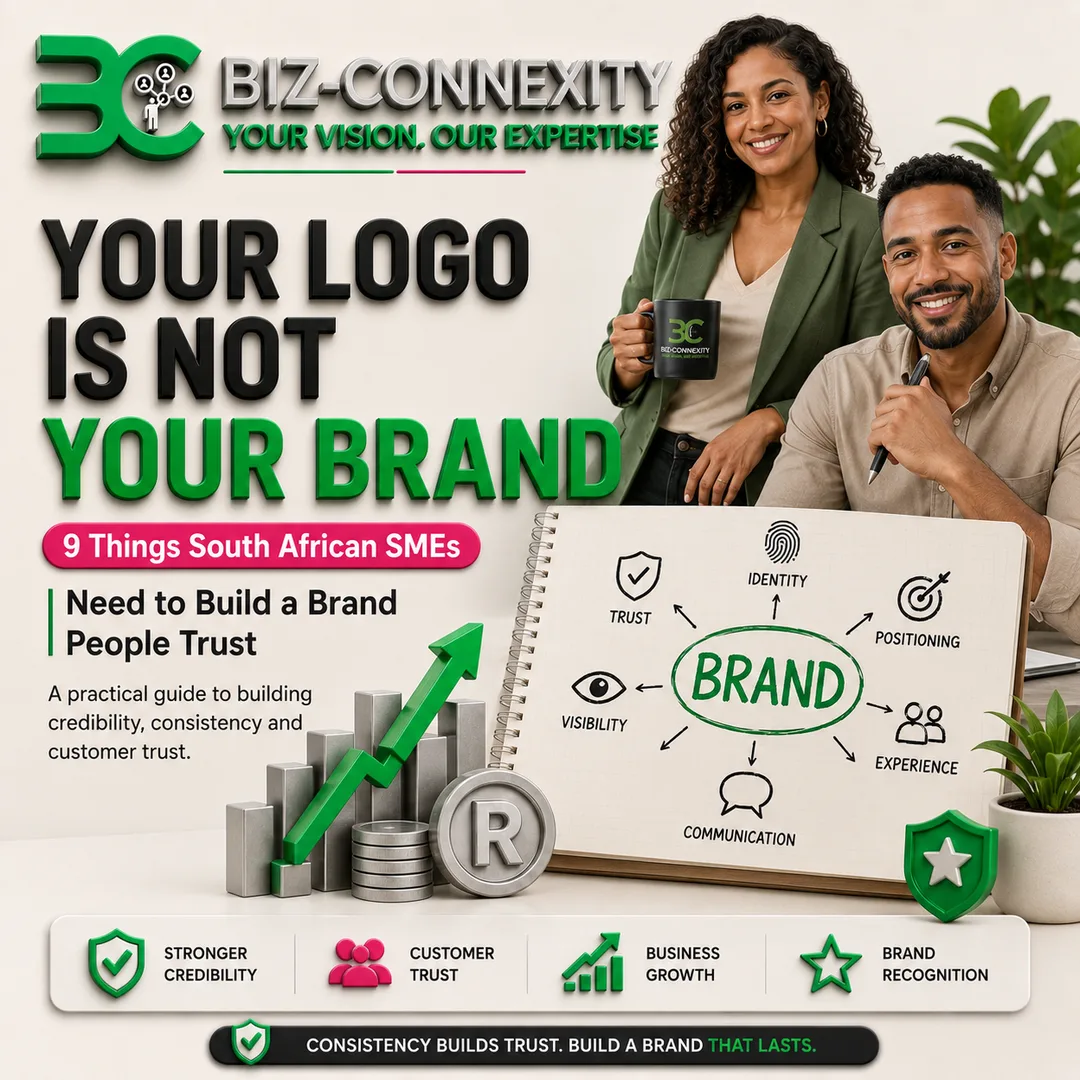
A logo identifies your business. Your brand is what people believe about it before they speak to you. For most South African SMEs the problem is not design quality, it is the distance between the standard of work they deliver and the standard customers assume they deliver. Bizconnexity calls that distance the Credibility Gap, and it is closed with nine practical elements: positioning, customer understanding, a brand promise, visual identity, messaging, consistency, customer experience, proof and visibility.
What branding actually is
Ask ten small business owners what their brand is and most will point at a logo. It is an understandable answer, because the logo is the only part of a brand that arrives as a file you can open. But the logo is the label on the tin. The brand is what people expect to find inside it.
A plumber in Mitchells Plain, a manufacturer in Epping and a guesthouse in Franschhoek all sell something people can judge only after they have bought it. Before that point, customers make a decision on evidence: how the quote is written, whether the vehicle looks maintained, whether the website loads, whether anyone answered the phone, whether other people have said good things. That evidence is your brand, and it is being built whether you manage it or not.
This matters commercially. A business with a weak brand is forced to compete on price, because price is the only thing a nervous customer can compare with confidence. A business with a strong brand gets asked about availability and lead times instead.
Working definition
Branding is the deliberate management of what people believe about your business. Design is one of the tools. Delivery, consistency and visibility are the rest.
The Bizconnexity Credibility Gap
In client work we keep meeting the same business: it does genuinely good work, keeps its promises, has loyal customers, and still loses opportunities to competitors who deliver less. The gap is not in the workshop. It is in the perception.
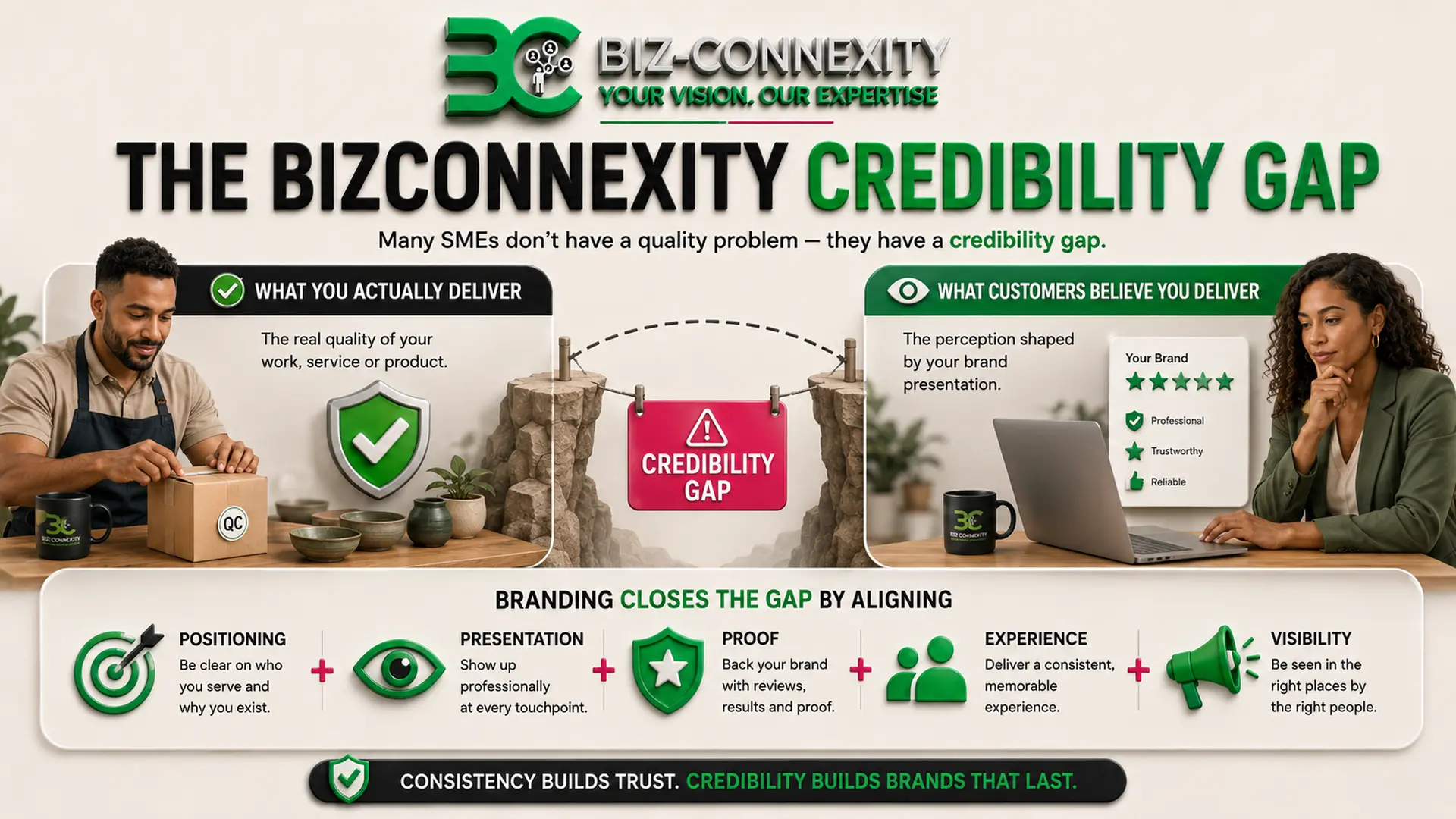
We call it the Credibility Gap: the distance between what you actually deliver and what a new customer believes you can deliver. Existing customers have crossed the gap through experience. Everyone else is standing on the other side of it, looking at your quote, your signage and your search results.
Five things close that gap, in this order:
- Positioning: being clear about who you serve and what you are best at.
- Presentation: looking like the standard of business you actually are.
- Proof: showing the work, the results and the people who vouch for you.
- Experience: making every interaction match the promise.
- Visibility: being findable at the moment someone is deciding.
This is a practical Bizconnexity model, not an industry standard. It is useful because it tells you where to spend next. If nobody can find you, more design will not help. If your quotes take four days, a new logo will not help either.
The 9 elements of a brand people trust
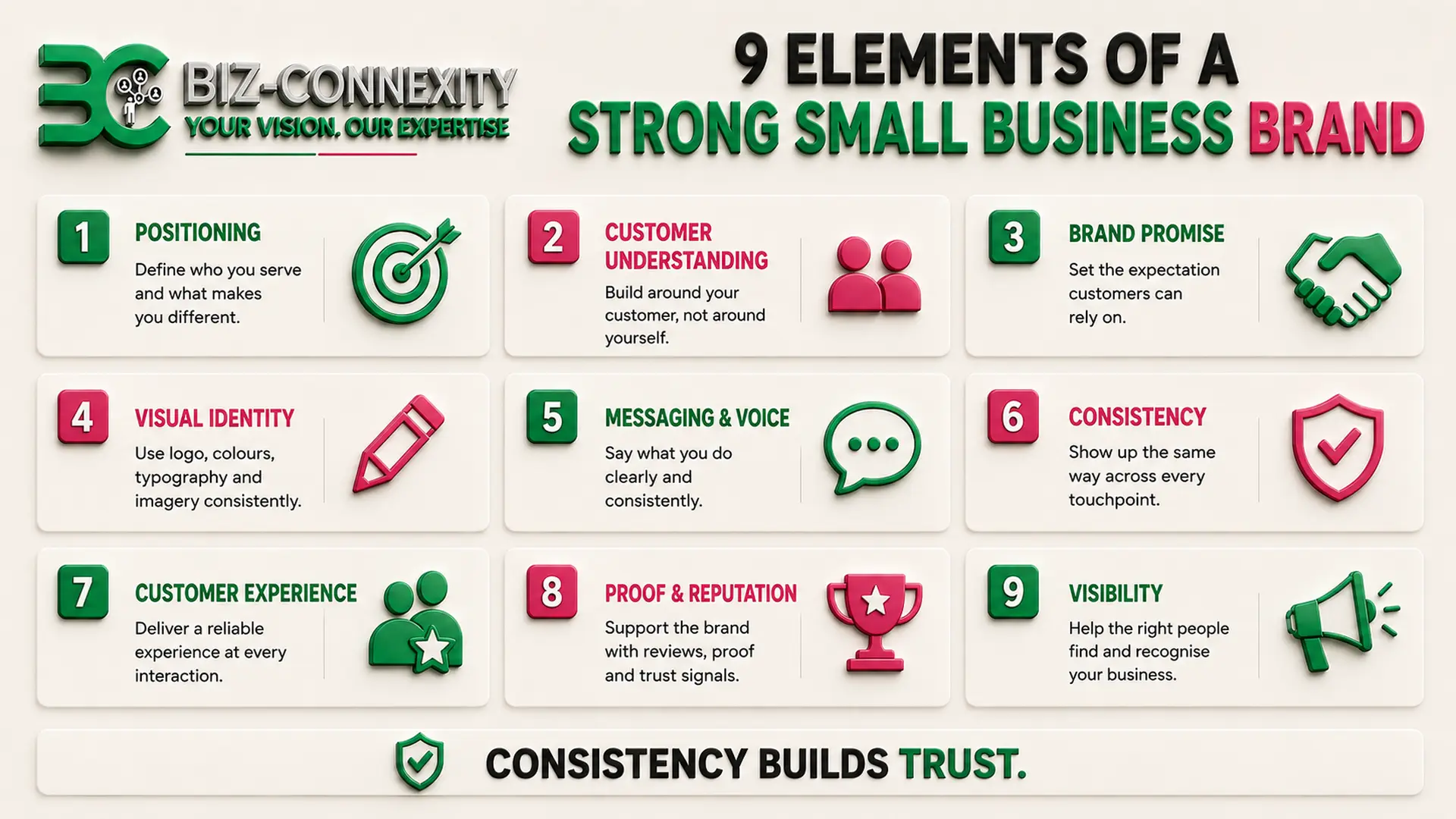
1. Positioning
Positioning is the decision about who you are for and what you want to be known for. It is the hardest element because it requires giving something up. A signage company that serves everyone competes with everyone; a signage company known for fast shopfront rollouts across the Cape Flats has a reason to exist in a customer's mind.
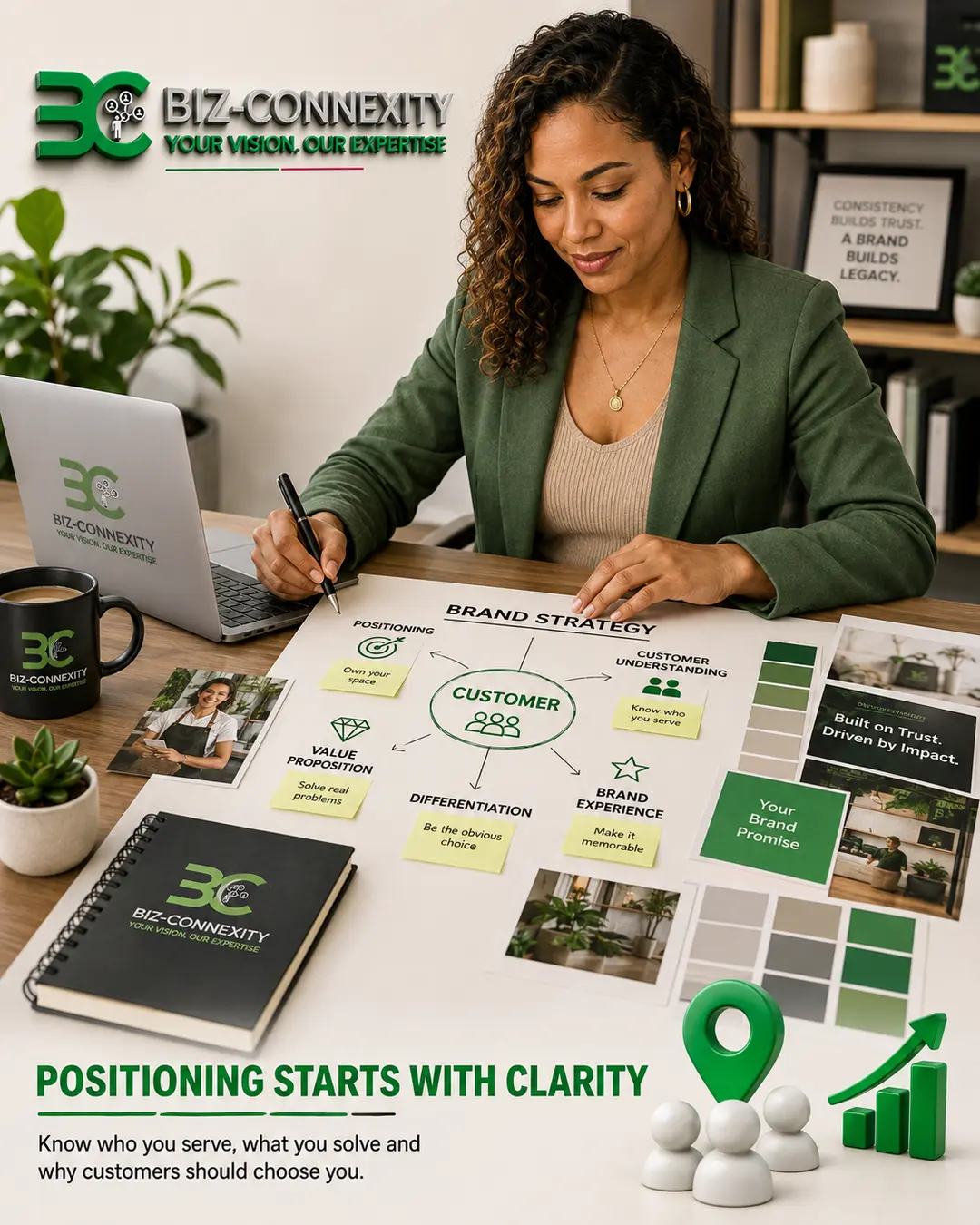
Write it down in a sentence a customer would recognise: we help X do Y, better than the alternatives, because of Z. If you cannot fill in Z honestly, that is the work to do before any design brief. Our brand identity and positioning work starts here rather than in a design programme.
2. Customer understanding
You cannot build trust with someone you have not described. Know what your customer is actually worried about: a Bellville workshop owner buying vehicle branding worries about downtime; a Durbanville professional buying a website worries about looking amateur next to a franchise. Brand language should answer the fear, not the feature.
The cheapest research available to an SME is the last twenty enquiries. Read what people asked before they bought. Those sentences are your messaging.
3. A brand promise
A promise is a specific, repeatable commitment: quotes within 24 hours, installation without closing the shop, a named contact from start to finish. It must be something you can keep on a bad week, because a broken promise damages more trust than a vague one ever built. South African consumer law also expects marketing claims to be truthful and not misleading, as set out in the Consumer Protection Act.
4. Visual identity
Now the logo, and everything around it: colour, typefaces, photography, layout. A usable identity is one that survives contact with reality. It must work in one colour on a delivery note, at three metres on shopfront signage, at speed on a branded vehicle, and at 40 pixels as a profile picture. Beautiful marks that fail those tests cost more than they save.
Names deserve a moment of care too. Registering a company is not the same as owning a name commercially. Check the CIPC trade marks information and, for a plain-language overview, WIPO's introduction to trade marks for SMEs, before you invest in a full rollout. If you are still setting up, our company registration support covers the registration side.
5. Messaging
Messaging is how you say it: your one-line description, the way you open a quote, the first sentence on your website, what your team says when the phone rings. Most SMEs describe their process when customers want the outcome. "We install in one night so you trade the next morning" beats "we offer a comprehensive signage solution".
6. Consistency
Consistency is the element that quietly does the most work and gets the least attention. Same logo, same colours, same tone, same contact details, everywhere. When the invoice, the van, the Facebook page and the shopfront agree with each other, a stranger reads "established". When they disagree, they read "risk".

Practically, this means one set of files and one short rules document that anyone can follow. It is why we produce print and signage collateral and website design from the same identity rather than treating them as separate jobs.
7. Customer experience
Every interaction is a brand asset or a brand liability: how quickly you answer, how the quote reads, whether the installer cleans up, whether anyone follows up. Marketing sets the expectation and operations either confirms it or contradicts it.
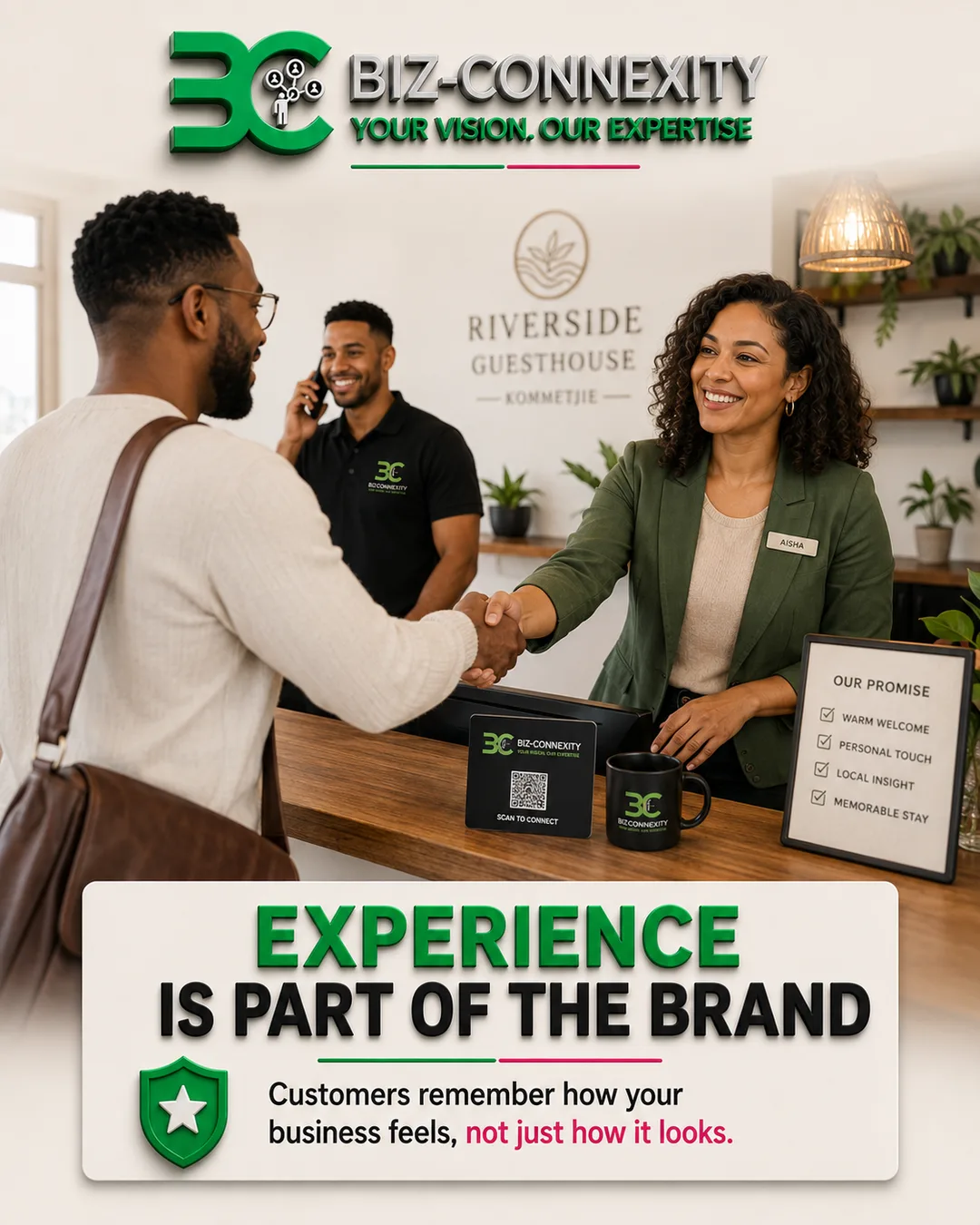
Map the five moments a customer actually touches your business, from first enquiry to final invoice, and fix the worst one first. A guesthouse in Hout Bay and a supplier in Paarden Eiland will have very different lists, and both will find something cheap to improve.
8. Proof
Proof is what converts interest into a decision: photographs of completed work, named testimonials, before and after images, client logos you have permission to use, review counts, years trading, accreditations. Collect it as you go, because reconstructing it later is painful.
For business-to-business and public-sector buyers, proof includes documented compliance. Tender-facing customers in Sandton or Gqeberha will ask for it before they ask about your work, which is why CSD, B-BBEE and SARS readiness and a proper company profile belong in the brand conversation.
9. Visibility
A brand nobody meets cannot build trust. Visibility means being present where decisions happen: search results, Google Maps, social feeds, physical signage on the street, and in the conversations of people who already use you.
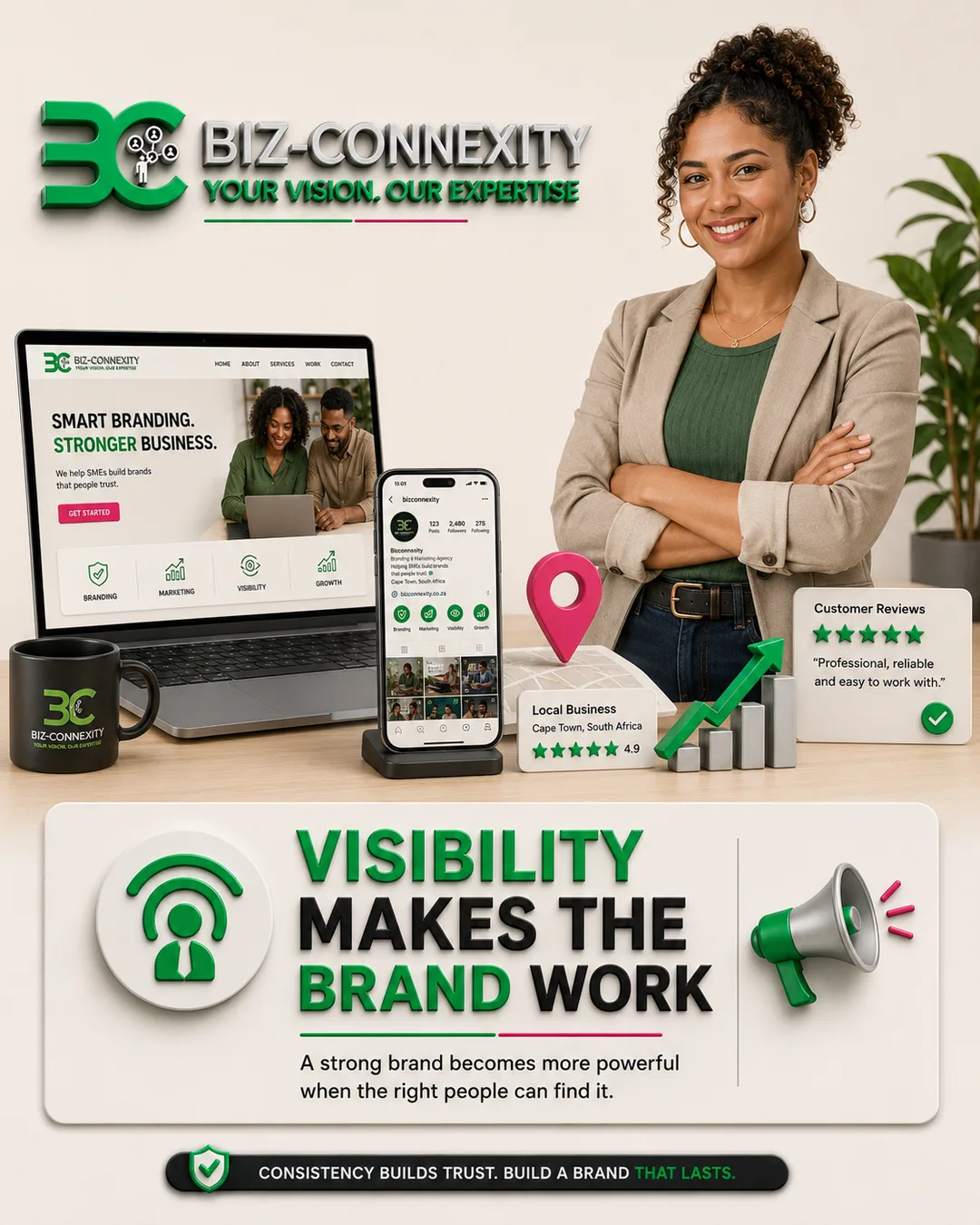
Start with the free, high-yield items: a complete Google Business Profile with real photographs and accurate hours, following Google Business Profile guidance, and a website that answers the questions customers actually ask, which is also what Google's helpful content guidance rewards. From there, SEO and local visibility, social media and broader digital marketing compound what the brand work has already set up. Businesses trading around Mitchells Plain and the Cape Flats often win more from local visibility than from paid reach.
Logo only vs a complete brand
The difference is easiest to see side by side. Both columns describe real businesses we have worked with; the second one simply made a set of decisions the first has not made yet.
| Touchpoint | Logo only | Complete brand |
|---|---|---|
| Positioning | Takes any work that comes | Known for a specific job, market or turnaround |
| Quote document | Plain template, price and total | Branded, explains scope, terms and next step |
| Website | One page, outdated, no proof | Answers real questions, shows work, easy to contact |
| Signage and vehicles | Logo applied at different sizes and colours | One system applied the same way everywhere |
| Social media | Occasional posts, inconsistent look | Recognisable format, regular proof of work |
| Proof | Says it does good work | Shows photographs, testimonials and references |
| Customer experience | Response time depends on the week | A promise the team can repeat on a bad week |
| Pricing conversation | Asked for a discount first | Asked about availability first |
A 14-point brand readiness check
Score one point for each statement that is true of your business today. Be strict: "we have it somewhere" does not count if your team cannot find it in a minute.
- 01You can state in one sentence who you serve and what you are best at.
- 02You know the three questions customers ask most often before buying.
- 03You have a written brand promise your team can repeat.
- 04Your logo exists in usable formats, including a one-colour version.
- 05Your colours and typefaces are written down, not remembered.
- 06Your quotes, invoices and profile use the same identity.
- 07Your signage, vehicles and premises match your digital presence.
- 08Your website loads quickly and explains what you do above the fold.
- 09Your Google Business Profile is complete, with real photographs.
- 10You post proof of work at least twice a month somewhere public.
- 11You have at least five testimonials or reviews you can show.
- 12You have photographs of recent completed work.
- 13Enquiries get a first response within one working day.
- 14Anyone in the team can answer 'what does your business do?' the same way.
Reading your score
11 to 14: your brand is doing its job, invest in visibility. 7 to 10: the foundations are there, consistency is the gap. 4 to 6: you are competing on price unnecessarily. 0 to 3: start with positioning and core collateral before spending on advertising. This is a practical diagnostic, not a certification or an official standard.
When to rebrand, and when not to
Rebranding is disruptive and expensive, and most SMEs who think they need one actually need consistency. Rebrand when there is a real reason:
- The name no longer describes what you sell, or limits where you can grow.
- You have merged, split, or changed ownership and the market needs to know.
- The identity is genuinely unusable in production, not just dated.
- There is a legal, trade mark or reputational reason to change.
- You are moving to a different customer, for example from consumer to tender work.
Do not rebrand because you are bored, because a competitor did, or because sales are slow. Slow sales are usually a visibility or offer problem, and a new logo will not change either. If cash is the constraint, look at growth and funding readiness before you look at design, and read our companion article on closing the SME funding readiness gap.
What branding does for growth
Branding is not decoration, it is a commercial lever. When perception matches capability, four things tend to change: you are shortlisted more often, you are questioned on price less often, referrals become easier because people can describe you, and recruitment gets simpler because good people can see what they are joining.
It also compounds. Every consistent touchpoint makes the next one cheaper to believe. A business in Brackenfell that fixed its quote template, its van and its Google profile in one quarter did not get more enquiries by magic; the same enquiries simply started converting, because nothing in the journey contradicted the promise.
Where you are not sure which constraint is real, an independent growth audit is a faster answer than guessing, and more of our thinking on SME growth sits in the Bizconnexity Insights hub.
How Bizconnexity helps South African SMEs
We work with owner-run businesses across South Africa, from Cape Town and Stikland to Clanwilliam, Springbok, Beaufort West, Durban and Gqeberha, and we build brands in the order that produces revenue rather than the order that produces admiration.
- Positioning and identity: the sentence, the mark, the rules that hold it together.
- Collateral: profiles, quote templates, cards, letterheads and printed material.
- Signage and vehicles: shopfronts, boards and wraps applied from one system.
- Website: a site that answers questions and can be found.
- Visibility: local search, Google Business Profile and social presence.
- Proof: photography, testimonials and case material collected as you work.
No inflated promises and no guaranteed rankings. We will tell you which of the nine elements is actually costing you work, and what it takes to fix it.
Frequently asked questions
Branding is everything that shapes what people believe about your business: your positioning, your promise, your visual identity, your messaging, the consistency of your materials, the experience customers have with you, the proof you can show and how visible you are. A logo is one element inside that system, not the system itself.
No. A logo is an identifier. A brand is the reputation attached to that identifier. Two businesses can use the same standard of logo and still be perceived very differently, because the rest of the brand, from quoting speed to signage quality, is doing most of the work.
There is no single figure. Costs vary by scope, by designer and by how much collateral you need. A more useful question is sequencing: get positioning, a workable identity and consistent core collateral in place first, then add items such as vehicle branding or a full signage rollout as revenue supports them.
Yes, in stages. Clarity, consistency and responsiveness cost very little and carry most of the trust. A clean identity applied the same way everywhere will out-perform an expensive logo used inconsistently.
Company registration and trade mark registration are different things. Registering a company with the CIPC does not by itself give you trade mark rights in the name. If your name and mark matter commercially, check the CIPC trade marks information and take advice before investing heavily in the identity.
The assets can be produced in weeks. Trust accumulates over repeated interactions, so plan in months and years rather than days. What you can control immediately is consistency, which is what shortens the trust cycle.
Look for the symptoms: you are asked for your price before you are asked about your work, referrals stall, customers are surprised by your capability once they meet you, or you lose tenders and quotes to businesses you know deliver less. Those are perception problems, not delivery problems.
Most SMEs need a tidy-up rather than a rebrand. Rebrand when the name, market or offering has genuinely changed, when the identity is unusable in practice, or when there is a legal or reputational reason. Otherwise, apply what you already have consistently first.
Where this connects next
Editorial note
This article is written and maintained by the Bizconnexity team from client work with South African SMEs. The Credibility Gap and the brand readiness check are practical Bizconnexity frameworks, not official standards or certifications. Legal points on names and trade marks are general information, not legal advice. We review the article when guidance from the cited sources changes.
Related articles
- Branding & WebsitesWhy Your Small Business Website Isn't Bringing You Customers: 11 Problems South African SMEs Should FixVisitors are not enquiries. Here is the Visibility-to-Enquiry Gap, the eleven faults that cause it on South African SME websites, and how to fix each one in order.Read the article →
- SME Funding & DevelopmentSouth Africa's SME Funding Paradox: 9 Ways to Close the Gap Between a Good Business and a Fundable OneOnly about 5% of formal South African MSMEs access credit, while SMEs carry roughly 34% of output and 60% of jobs. Here is what the Funding Readiness Gap is, and nine practical ways to close it.Read the article →
About the author
David Gous
Founder, Bizconnexity
David Gous is the founder of Bizconnexity, where he focuses on helping South African SMEs solve practical business challenges across strategy, compliance, branding, digital growth and funding readiness.
Primary sources reviewed
How this article was researched
- CIPC trade marksOfficial South African guidance on trade mark registration and protection.
- WIPO, Making a Mark: an introduction to trademarks for SMEsPractical trade mark and brand-protection guidance written for smaller businesses.
- Google Business Profile HelpHow business information, photos and reviews appear in Search and Maps.
- Google Search Central, creating helpful contentWhat search systems look for in trustworthy business content.
- Consumer Protection Act 68 of 2008South African rules on marketing claims and fair dealing with customers.
Last evidence review: 1 September 2026. Funding requirements change between providers and over time, so verify current eligibility, cost and application requirements directly with the relevant institution.