
SME Funding & Development
South Africa's SME Funding Paradox: 9 Ways to Close the Gap Between a Good Business and a Fundable One
SME funding South Africa: understand the Funding Readiness Gap and use 9 practical steps to build stronger records, improve funding readiness and prepare a better finance application.
By David Gous · Published 31 August 2026 · 16 min read

In short
SME funding in South Africa remains difficult because funders need evidence that capital can be repaid, while smaller businesses often lack long trading histories, strong financial records, traditional collateral or the resources needed to satisfy complex application requirements. In September 2025 the International Finance Corporation reported that only about 5% of formal South African MSMEs had access to credit, despite SMEs contributing roughly 34% of economic output and 60% of jobs. Bizconnexity calls the distance between a genuine commercial opportunity and a financeable one the Funding Readiness Gap.
The businesses that can win the work but cannot fund the work
You spend months chasing a decent customer. The quotation goes out, meetings happen, documents are submitted, and then the call comes: you got the contract. For a few minutes everything feels like it is moving in the right direction.
Then you calculate what it will actually cost to deliver. You need stock. Your supplier wants a deposit. You may need another employee. There is transport to arrange. The customer wants delivery before month-end. The invoice will only be paid 30 or 60 days later. Suddenly your biggest opportunity becomes your biggest cash-flow problem.
You approach a funder, and another list arrives: financial statements, management accounts, bank statements, turnover history, cash-flow forecasts, contracts, tax information, collateral, credit history, owner contribution and proof that you have handled an order of this size before.
That is where many owners become frustrated. You need money because the business has reached the point where it can grow. The funder wants evidence that the growth has already happened. It is easy to publish lists of funding institutions. It is harder to answer the question entrepreneurs actually have: why can I have a real business opportunity and still struggle to finance it?
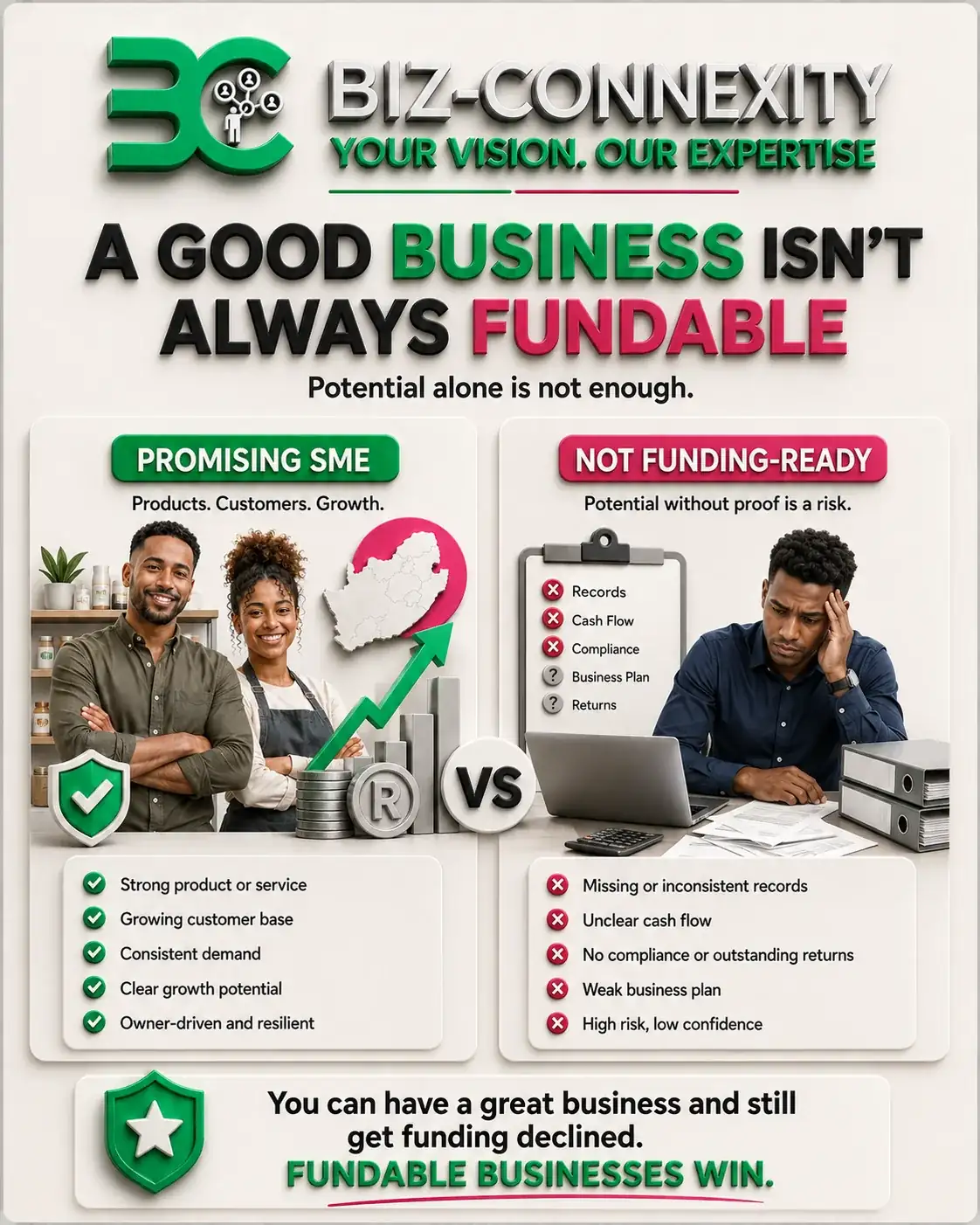
SME funding South Africa: what the numbers tell us
The gap is not simply anecdotal. The International Finance Corporation reported in September 2025 that only about 5% of formal South African MSMEs had access to credit, while SMEs contribute roughly 34% of economic output and 60% of employment.
34%
of South Africa's economic output comes from SMEs
60%
of employment sits with SMEs
5%
of formal MSMEs access credit
Those numbers should make us uncomfortable. Small businesses are expected to be a major source of employment and economic participation while access to formal finance remains limited. So SME funding in South Africa cannot be reduced to "there are funders available". The more useful question is whether an ordinary entrepreneur can actually access the right finance at the point where the business needs it.
Collateral remains part of the problem
Many SMEs have economic value without owning much fixed property. A manufacturer may have machinery. A retailer may have inventory. A service business may have invoices outstanding from reputable customers. A supplier may hold a confirmed purchase order. Another business may have recurring monthly revenue. Yet conventional finance has historically placed significant weight on fixed collateral.
National Treasury's financial inclusion policy discusses the limitations of South Africa's movable collateral environment and the potential role of reforms that make it easier for SMEs to use movable business assets as security. A small business can be commercially active without owning the assets that make a traditional lender most comfortable. That does not mean lenders should ignore risk. It means we should keep asking whether the system recognises enough forms of legitimate business value.
Different approaches to SME finance are already emerging
In May 2025, IFC announced a risk-sharing facility with FirstRand covering half the credit risk on a portfolio of up to R1.8 billion in SME loans, and it specifically includes women-owned SMEs among the businesses it aims to support. The important part is the mechanism. Instead of telling every SME to become less risky first, a risk-sharing structure asks whether the financing system itself can carry risk differently.
The Funding Readiness Gap
Bizconnexity defines the Funding Readiness Gap as the distance between having a commercially credible business opportunity and possessing enough financial evidence, operational history, institutional readiness and repayment credibility for the right capital provider to finance that opportunity.
A business can therefore be viable without yet being funding ready. This matters because entrepreneurs frequently read a rejection as "my business is not good enough". That may not be the real problem. It could be documentation, financial visibility, the funding product, timing, insufficient commercial evidence, repayment capacity, or simply the wrong funder. Understanding the gap changes the next move.

The six parts of funding readiness
Our model evaluates six connected areas.
1. Commercial evidence
Can you prove that customers genuinely want what you sell?
- Invoices
- Contracts
- Purchase orders
- Repeat customers
- Deposits
- Subscriptions and transaction history
2. Financial visibility
Can somebody outside the business understand how money moves through it?
- Revenue
- Costs
- Margins
- Cash flow
- Debtors and creditors
- Existing debt
3. Operational capacity
Can the business actually deliver the work the funding is supposed to support?
- People
- Equipment
- Suppliers
- Production
- Systems
- Fulfilment
4. Institutional readiness
Are the records and compliance requirements needed by that particular funding provider in place? An entity whose CIPC and SARS records are current is the baseline, which is what business registration and compliance support exists to fix, and then SARS, B-BBEE and CSD registration support usually earns its keep. Presenting well matters too: funders and corporate buyers read a professional brand and company profile as a signal that the business is run properly. Businesses pursuing public-sector or corporate supply-chain work should also review CSD, B-BBEE and tender readiness, since larger contracts add working-capital pressure of their own.
5. Capital fit
Are you applying for the correct type of money? A temporary working-capital problem should not automatically be financed like a long-term asset purchase.
6. Repayment resilience
Can the business repay the capital without starving itself of cash? This part is often overlooked. Getting approved is not the goal. Being financially stronger after taking the money is.
The model
Commercial evidence + financial visibility + operational capacity + institutional readiness + capital fit + repayment resilience. This is a diagnostic framework, not a lender scoring formula. No framework can guarantee funding. Its purpose is to identify what needs work before another application is submitted.
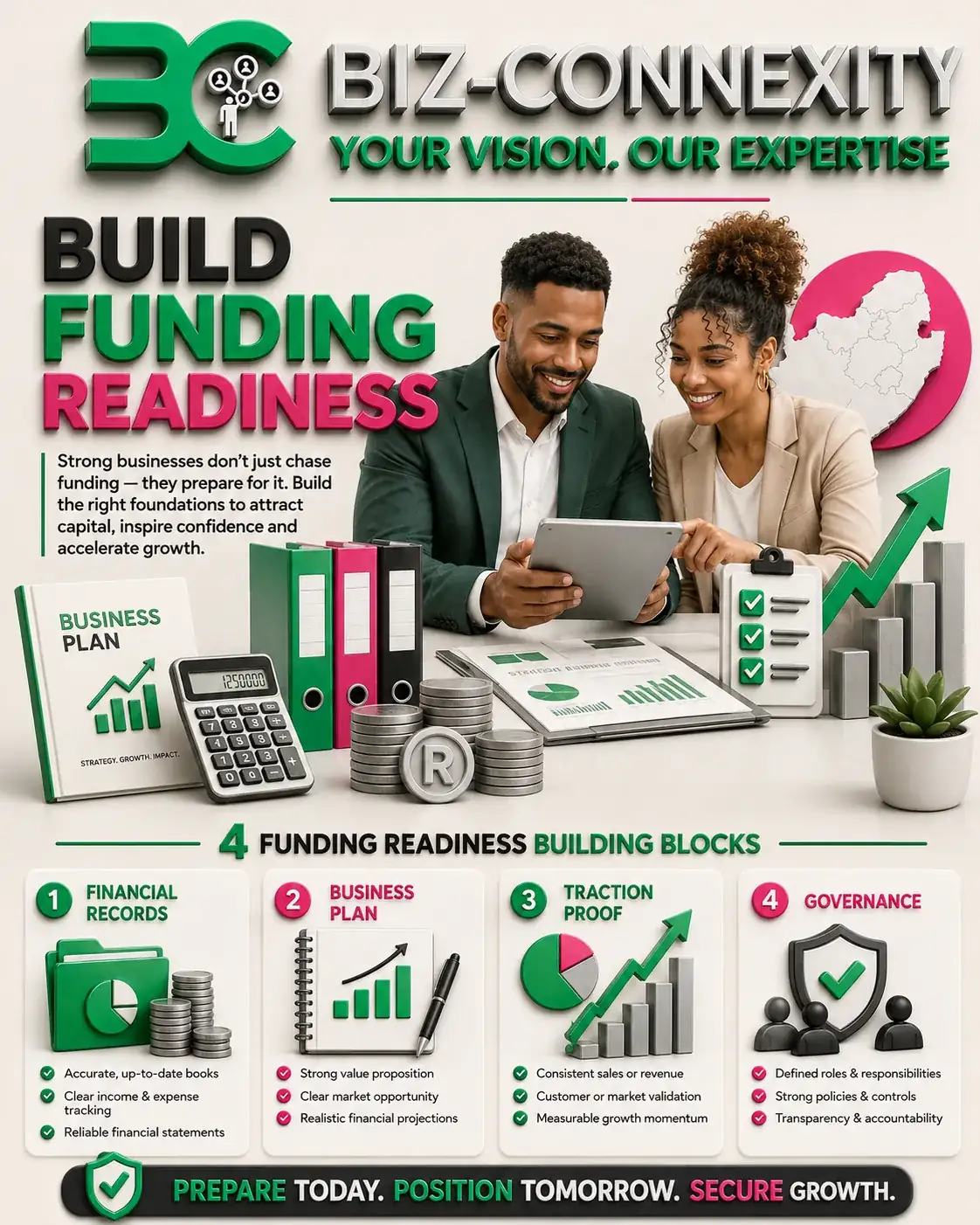
The SME funding catch-22
Suppose an SME receives an order worth R520,000 and needs R300,000 to buy stock and complete the work. The business approaches a funder. Have you completed orders of this size before? No, that is why this order matters. Do you have R300,000 of working capital already? No, that is why funding is required. Do you have significant assets to secure the finance? Possibly not.
The business needs capital to create the operating history that could make it easier to finance later, but it is being asked for that history now. The cycle becomes: win a bigger opportunity, need additional capacity, need capital, apply for finance, funder wants proof of existing capacity, need bigger opportunities to create that proof, need capital.
Timing makes this worse. An SME does not operate in a spreadsheet. Customers have deadlines, suppliers have deadlines, purchase orders expire and projects start. A funding approval three months after the commercial opportunity disappears may be practically useless. So funding access should not only ask whether money was theoretically available. It should ask whether the right business could obtain appropriate capital, at a sustainable cost, while the opportunity still existed.
Why unequal starting points can create unequal funding outcomes
Two entrepreneurs can complete the same funding application while arriving there from completely different starting points. One founder may have family savings, property, professional networks, an accountant, access to early customers, relatives with business experience and a financial cushion. Another may have no inherited assets, significant household responsibilities, little access to professional advice, no property, limited networks and no safety net if a customer pays late.
Both eventually appear before the same funding criteria. One looks stronger. But the difference was not created entirely by business ability. Some of it existed before either application began.
This matters when we discuss funding for women-owned businesses, young founders, township entrepreneurs and rural businesses. An application process can be formally equal while applicants arrive with very unequal access to the assets, networks and early capital needed to satisfy it. That does not prove that every individual rejection is discriminatory. It does mean we should be careful about treating the final funding decision as though it exists completely outside South Africa's wider economic history.
Which Funding Readiness Gap do you have?
| What is happening in the business? | Likely gap | What the funder may see | What to investigate first |
|---|---|---|---|
| Strong sales but poor records | Financial visibility | Risk cannot be quantified | Management accounts and bookkeeping |
| Large order but insufficient stock cash | Capital fit | Fulfilment risk | Working-capital or contract finance |
| Great idea but few paying customers | Commercial evidence | Demand uncertainty | Customer validation |
| Profitable business but limited collateral | Capital fit | Recovery risk | Alternative security or finance structure |
| Repeated incomplete applications | Institutional readiness | Administrative risk | Funding-readiness file |
| Fast loan but repayments consume most margin | Repayment resilience | Future default risk | True finance cost |
| Plenty of demand but poor delivery capacity | Operational capacity | Execution risk | Staff, systems and fulfilment |
| Constant cash shortages despite sales | Financial visibility | Underlying instability | Cash-flow diagnosis |
This is why the question "where can I get funding?" often comes too early. First identify the gap. Then identify the money.
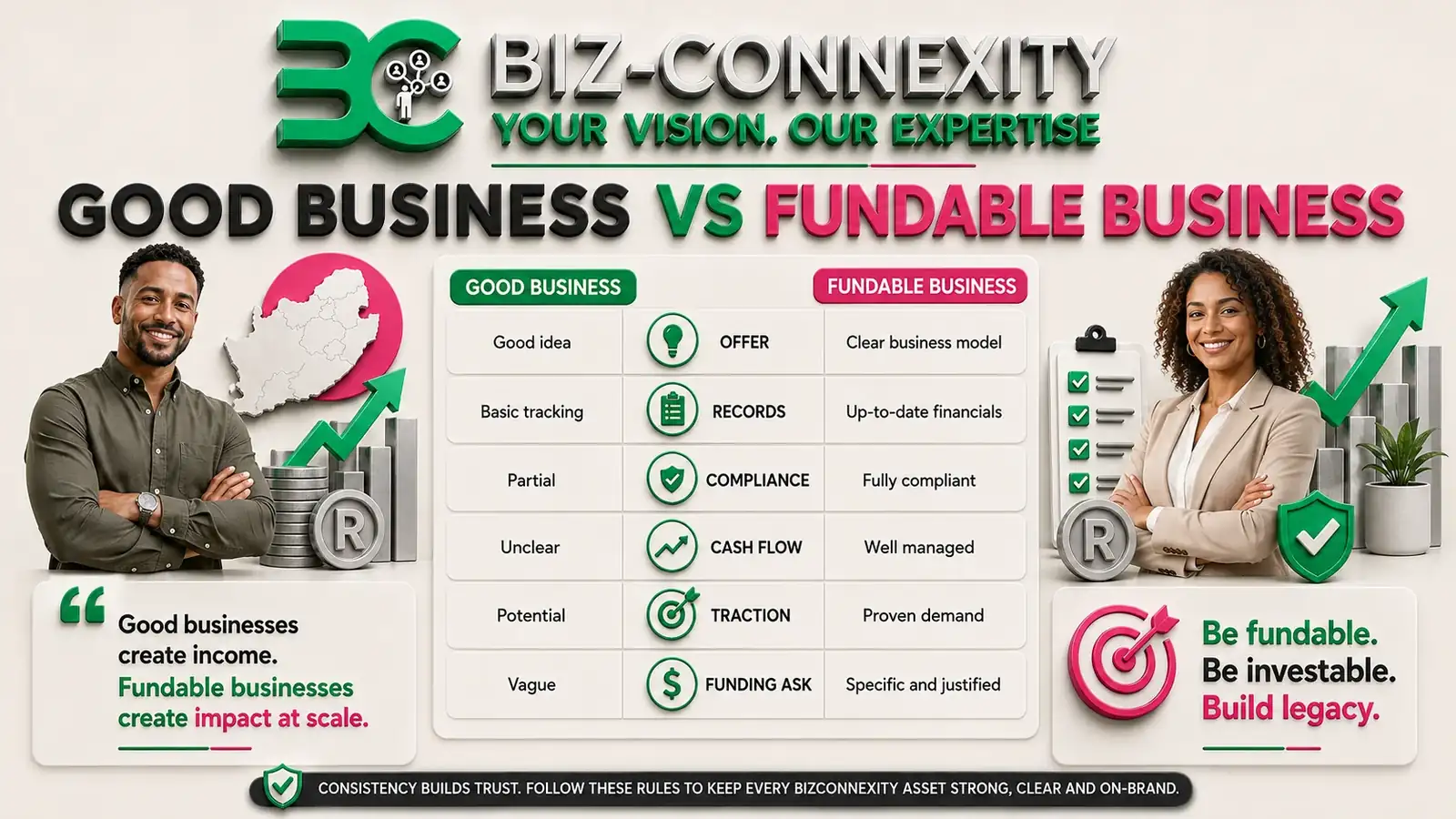
9 ways SMEs can close the Funding Readiness Gap
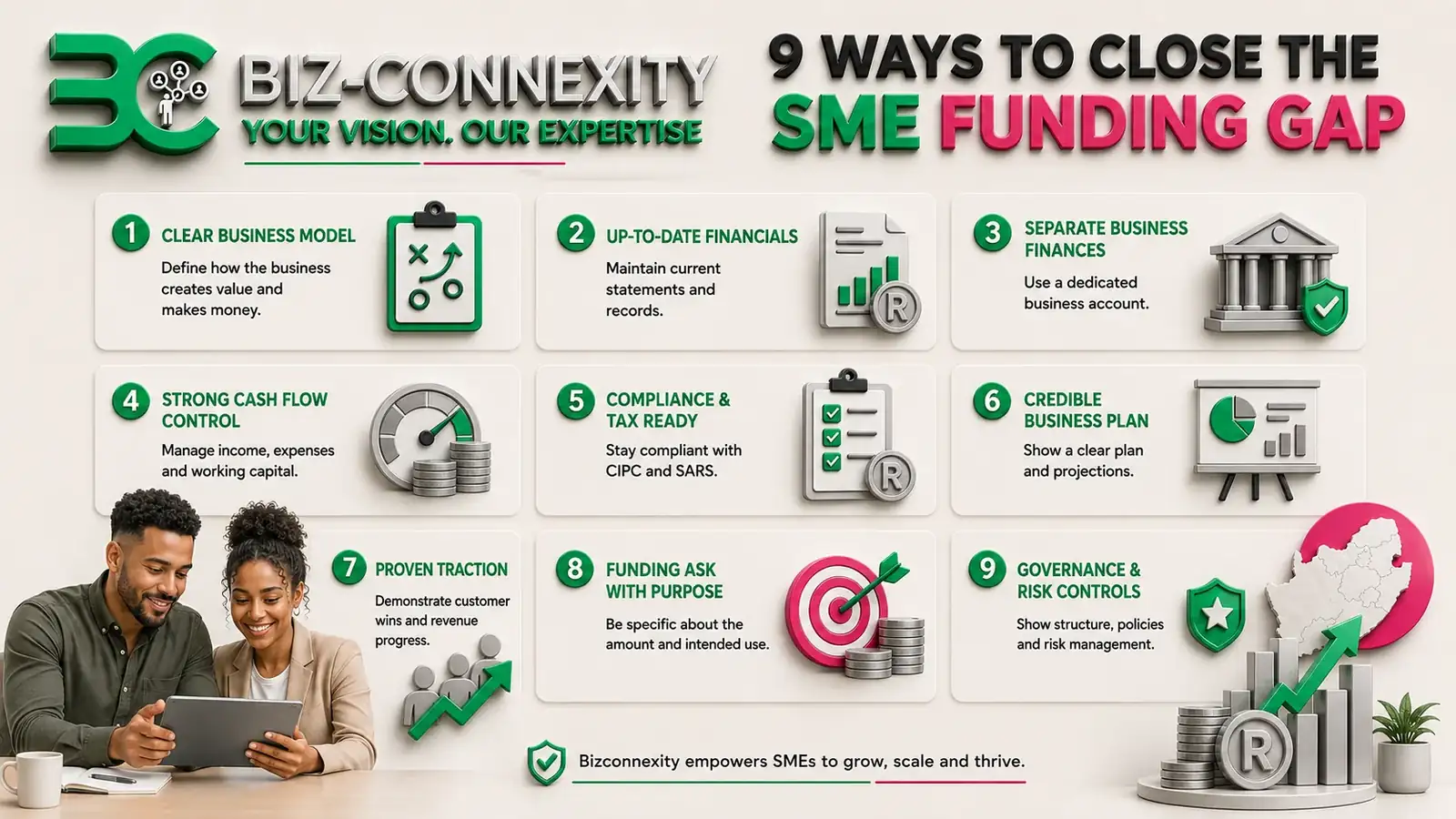
1. Diagnose the rejection before applying again
Sending the same business to five more funders without understanding what went wrong can waste months. Ask what failed: turnover, affordability, records, collateral, credit history, compliance, industry risk, repayment capacity or funding purpose. Different causes require different solutions.
Action
Create a funding-gap register and record every barrier a funder identifies.
2. Build financial visibility before you need finance
Do not wait for an application before organising the numbers. You should gradually be able to answer: how much did we sell last month, what did it cost to produce those sales, what is our gross margin, who owes us money, who do we owe, how much cash is actually available, and what happens if our biggest customer pays 30 days late. Good records are not paperwork created for funders. They are how you see your own business.
Action
Prepare a simple monthly management report covering revenue, cost of sales, gross profit, overheads, cash, debtors and creditors.
3. Stop asking for funding "to grow"
Growth is not a use of funds. It is an outcome. Compare "we need R500,000 to grow" with "we require R500,000 to purchase raw materials and add the production capacity needed to fulfil confirmed customer orders". The second creates a clear path: money, activity, commercial result, cash flow, repayment. That makes the business easier to assess, and it is exactly what a properly built business plan and company profile should carry. If you are not yet sure whether applying is the right move, a growth and funding readiness assessment answers that first.
Action
Prepare a one-page use-of-funds statement explaining exactly what the money will do.
4. Turn customer demand into evidence
You may know customers want the product. A funder needs to see why you believe that. A predictable pipeline is easier to evidence than a good month, which is where digital marketing and local search visibility stop being marketing spend and start being traction data.
- Purchase orders
- Contracts
- Deposits
- Repeat invoices
- Subscriptions and letters of intent
- Transaction records
Action
Build a secure commercial evidence folder and keep it current.
5. Find out whether funding is actually the problem
Sometimes the business genuinely needs capital. Sometimes money is merely the symptom. Cash shortages may come from low pricing, weak gross margins, slow-paying customers, uncontrolled expenses, too much stock, excessive owner drawings, poor debt collection or expensive existing finance. Borrowing into a structurally weak business buys time without solving the real problem. Then repayments start, and now there are two problems.
Action
Diagnose why cash is short before financing the shortage.
6. Calculate the true cost of the money
Do not stop at the monthly instalment. Calculate the full picture.
- Amount borrowed
- Total interest
- Initiation fees
- Service charges
- Repayment frequency
- Insurance where applicable
- Penalties
- Total rand repayment and personal surety
Then ask how much gross profit this opportunity must generate merely to pay for the finance. A loan can increase turnover while reducing the owner's economic return. That is not growth.
Action
Calculate total repayment and finance cost before signing.
7. Maintain a funding-readiness file
Do not recreate your business administration every time a funding programme opens. Keep current copies of company records, ownership information, financial statements, management accounts, bank statements, forecasts, contracts, tax information where required, your business plan, funding motivation, company profile and relevant compliance records. Protect sensitive information: never upload identity documents or confidential financial records to public web pages.
Action
Review the file quarterly.
8. Match the funding product to the problem
Different problems need different forms of capital.
- Working-capital finance
- Asset finance
- Invoice finance
- Purchase-order finance
- Revolving credit
- Equity
- Grants
- Guarantees, blended finance and supply-chain finance
Do not start by asking which funder will give you money. Ask what type of capital actually fits this business problem.
Action
Write down whether the money is needed for stock, equipment, a temporary payment gap, contract fulfilment or long-term expansion.
9. Turn every rejection into data
Keep a funding application register recording the institution, product, amount requested, submission date, response time, outcome, rejection reason, questions asked, documents requested and lessons learned. If several funders identify the same weakness, the pattern deserves attention. Fix the underlying issue before starting another round.
Action
Treat rejection as business intelligence rather than another closed door.
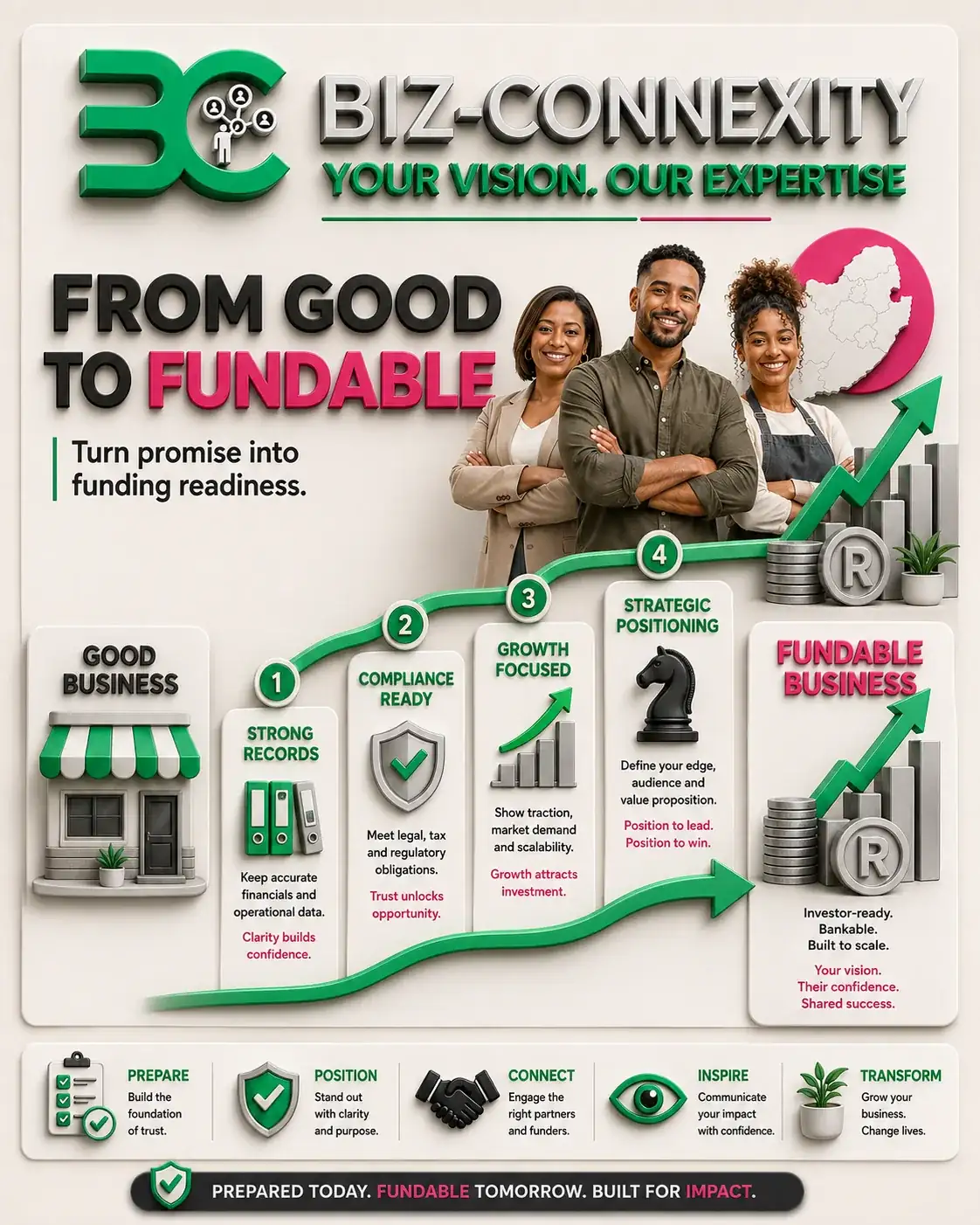
Sometimes the best funding decision is not to borrow
Not every funding opportunity should be taken. Imagine you win a contract worth R500,000 that produces R100,000 in expected gross profit, and you need emergency finance to deliver. After fees and interest the finance costs R70,000. You are taking operational risk, customer risk and repayment risk to retain R30,000 before considering many other costs.
That deal may still make sense. It may not. The point is that access to money should never replace commercial judgement. Rejecting bad capital can protect a business just as much as finding good capital can grow one.
7 SME funding red flags
Be cautious when someone:
- 01Guarantees funding approval
- 02Demands a large upfront payment for guaranteed access to funding
- 03Claims to have a secret insider who can approve the application
- 04Refuses to explain the total amount repayable
- 05Pressures you to sign immediately
- 06Asks for banking passwords, PINs or OTPs
- 07Cannot clearly identify the lender or institution providing the money
A genuine funding process may involve fees, advisers and complicated requirements. What it should not require is blind trust. Verify before you pay, before you sign, and before you hand over sensitive information.
What government and development institutions must change
Entrepreneurs have responsibilities. Institutions do too. Telling every business to become funding ready cannot become an excuse for ignoring whether the funding system itself is unnecessarily difficult to navigate.
Publish the actual funding funnel
When R500 million or R2 billion in SME funding is announced, the public should eventually be able to understand what happened.
- Applications received and completed
- Approvals and rejections
- Reasons for rejection
- Turnaround times
- Amounts approved and disbursed
- Geographic distribution, business size and sector
- Outcomes after funding
An allocation is not an approval. An approval is not a disbursement. A disbursement is not automatically a successful economic outcome. All four should be measured.
Tell entrepreneurs why they were rejected
"Application unsuccessful" is not developmental feedback. Was the problem credit, turnover, cash flow, security, documentation, business viability, industry or compliance? A development institution may not be able to fund every business. It can still leave unsuccessful applicants with useful information.
Make SME finance easier to navigate
Small-business owners frequently deal with multiple systems across company registration, tax, banking, procurement, supplier registration, funding and regulatory compliance. SEDFA's current Annual Performance Plan forms part of the country's small-enterprise development framework. The question should not only be whether processes have been redesigned on paper. It should be whether the entrepreneur actually experiences less friction.
What large companies and procurement teams need to understand
A small supplier can win a large contract and become poorer because it won. That sounds absurd. It happens when the supplier must finance stock, staff, transport, production, compliance and delivery while the larger customer pays weeks later. The SME is effectively helping finance the buyer's payment cycle.
If supplier development is serious, procurement teams should examine:
- Payment terms
- Deposits
- Invoice approval delays
- Early-payment mechanisms
- Purchase-order finance
- Supplier onboarding delays and contract size
Teaching an SME how to win a tender is only half the job. The stronger question is whether the supplier can survive delivering it.
What business advisers need to stop telling entrepreneurs
One sentence should disappear from the SME consulting industry: "get a professional business plan and you will get funding."
A good business plan can explain the business, market, strategy, forecasts, funding need and commercial assumptions. It cannot create demand, cash flow, good margins, repayment ability, trading history or collateral. No credible adviser should guarantee finance merely because they wrote the application. The purpose of a business plan is to make a real business easier to understand, not to make a weak business look stronger than it is.
A 90-day Funding Readiness Gap plan
| Period | Business action | Question to answer | Evidence |
|---|---|---|---|
| Days 1 to 30 | Audit records, cash flow, compliance and debt | What would stop us qualifying today? | Missing documents, financial weaknesses and compliance gaps |
| Days 31 to 60 | Build forecasts, customer evidence, use of funds and the repayment case | Can we prove why the capital is needed? | Orders, margins, forecasts and contracts |
| Days 61 to 90 | Identify suitable funding products and submit targeted applications | Are we applying to the right capital provider? | Applications, turnaround times, approvals and rejection reasons |
The purpose of this plan is not to produce more applications. It is to produce a stronger business. If you want help working through it, see how we work or read about our SME development support.
A message to the entrepreneur behind the application
If you have been rejected for funding, ask why. Do not let a generic email decide what you believe about yourself or your business. Sometimes the business needs work. If your books are poor, fix them. If your margins cannot support debt, do not pretend they can. If your funding requirement does not make sense, recalculate it. If there is no evidence of demand, build that evidence.
But sometimes the problem is different: wrong funder, wrong product, wrong timing, wrong stage, or a process built around businesses more established than yours. Know what you are dealing with. Keep the rejection, keep the criteria, keep the paperwork, and learn from the pattern.
And be very careful with desperation. Desperate entrepreneurs are easier to sell expensive money to. Do not pay thousands of rand because somebody says they have a contact "inside". Do not give banking passwords or OTPs to anyone. Do not accept expensive finance without knowing exactly what it will cost.
The point
Build the strongest business you can, then find capital that serves the business. Do not build a business whose main purpose becomes servicing the capital.
Frequently asked questions
Financiers need reliable evidence of repayment capacity, while smaller businesses may have shorter trading histories, weaker records and fewer conventional assets to use as collateral. The problem is therefore both a funding-system challenge and a business-readiness challenge.
It is the difference between having a commercially credible opportunity and possessing enough financial evidence, operational capacity, institutional readiness and repayment credibility to satisfy an appropriate funder. It is a Bizconnexity diagnostic concept rather than an official government funding classification.
A funding-ready SME should normally be able to explain what it sells, who buys it, how much it earns, how cash moves, what capital is required, what the money will do, what risks exist and how repayment will happen. Individual requirements depend on the finance provider.
Possibly. Some products may consider cash flow, invoices, contracts, purchase orders, guarantees or other forms of evidence. Requirements differ between lenders. The absence of property does not necessarily mean no finance exists, but it can narrow the available options.
It depends on the finance provider, legal structure and product. Some lenders consider director or owner credit history when assessing smaller businesses. Do not assume that one rejection means no finance is available. Ask what caused the decline.
No. A purchase order can strengthen an application, but funders may still assess the customer, the supplier, delivery capacity, margins, payment terms and commercial risk. Be cautious of anyone promising guaranteed approval because you hold a purchase order.
No. A business plan can strengthen an application by making the business easier to assess. It does not guarantee finance.
There is no universal timeline. It depends on the lender, funding programme, facility size, documentation and due diligence required. For contract-based opportunities, ask about likely turnaround time before applying, because late funding can be commercially useless.
Yes. Some development and commercial finance initiatives specifically target women-owned SMEs. For example, the IFC 2025 risk-sharing facility with FirstRand included women-owned SMEs among its intended beneficiaries.
Look at why the cash shortage exists. Funding can make sense for a temporary working-capital gap, a confirmed contract requirement or a productive asset investment. If the real problem is low margins, poor demand or uncontrolled costs, borrowing may simply delay it. Diagnose before you finance.
Where this connects next
- Business plansPut the use of funds, forecasts and repayment case on paper properly.
- SARS, B-BBEE & CSD supportClose the institutional readiness gap before the next application.
- Growth & funding readinessWork out which readiness gap to close before applying again.
- Growth AuditFind out which of the six gaps is actually holding your business back.
Related articles
- Branding & Business GrowthYour Logo Is Not Your Brand: 9 Things South African SMEs Need to Build a Brand People TrustA logo is one small part of a brand. Here are the nine elements South African SMEs need to close the Credibility Gap and build the trust that wins better customers.Read the article →
- Branding & WebsitesWhy Your Small Business Website Isn't Bringing You Customers: 11 Problems South African SMEs Should FixVisitors are not enquiries. Here is the Visibility-to-Enquiry Gap, the eleven faults that cause it on South African SME websites, and how to fix each one in order.Read the article →
About the author
David Gous
Founder, Bizconnexity
David Gous is the founder of Bizconnexity, where he focuses on helping South African SMEs solve practical business challenges across strategy, compliance, branding, digital growth and funding readiness.
Primary sources reviewed
How this article was researched
- IFC on SME access to finance in South AfricaSouth African MSME credit access and FirstRand risk-sharing initiatives.
- National Treasury, An Inclusive Financial Sector for AllFinancial inclusion, SME finance constraints and movable collateral.
- SEDFA Annual Performance Plan 2026/27Current small-enterprise development and finance planning.
Last evidence review: 31 August 2026. Funding requirements change between providers and over time, so verify current eligibility, cost and application requirements directly with the relevant institution.