
Branding & Websites
Why Your Small Business Website Isn't Bringing You Customers: 11 Problems South African SMEs Should Fix
Your website gets visitors but no enquiries. Here are the 11 problems costing South African SMEs customers, and the practical fix for each one.
By David Gous · Published 1 September 2026 · 15 min read

In short
A website that gets visitors but no enquiries is not failing at design, it is failing at one of five steps: clarity, relevance, trust, ease and action. Bizconnexity calls the distance between a visit and an enquiry the Visibility-to-Enquiry Gap. Eleven faults create it on most South African SME sites, and every one of them can be fixed without a rebuild. Start with what your homepage says, then speed, then proof, then contact.
Visitors are not customers
Almost every owner who calls us says the same thing in the first minute: people visit the site, nobody phones. Sometimes the analytics show a few hundred visitors a month, sometimes a few thousand. The enquiry count is the same either way, which is the clue. If more traffic is not producing more enquiries, traffic is not the constraint.
A website has two jobs and they fail independently. The first job is being found by the right person at the right moment. The second is convincing that person to act while they are still on the page. A plumber in Mitchells Plain can be top of the local results and still lose every visitor to a phone number nobody can see on a phone. A specialist supplier in Epping can have an excellent, persuasive site that only twelve people ever open.
Before you change anything, work out which of the two is broken. Open your analytics. Low visitor numbers with reasonable enquiries per visitor is a visibility problem. Solid visitor numbers with almost no enquiries is a conversion problem. Both together means you fix conversion first, because sending more people to a page that does not work is expensive.
The distinction that saves money
Visibility work takes weeks to months to show up. Conversion work can change results this week, because it acts on the people already arriving. Fix the leak before you open the tap.
The Bizconnexity Visibility-to-Enquiry Gap
In site audits we keep finding the same shape of problem, so we gave it a name. The Visibility-to-Enquiry Gap is the distance between someone landing on your website and someone contacting you. Five things have to happen in sequence, and the visitor leaves at the first one that fails.

- 01Clarity: within about five seconds they understand what you sell, who it is for and where you operate.
- 02Relevance: the page matches what they searched for, not a generic homepage.
- 03Trust: something on the page tells them you are real, competent and safe to contact.
- 04Ease: the site loads quickly, reads well on a phone and does not make them work.
- 05Action: there is one obvious next step, visible without scrolling for it.
This is a practical Bizconnexity model rather than an industry standard, and its value is diagnostic. If visitors leave in under ten seconds, you have a clarity or speed problem. If they read three pages and never contact you, you have a trust or action problem. The eleven faults below are simply the specific ways each of these five steps breaks.
The 11 problems, and how to fix each one
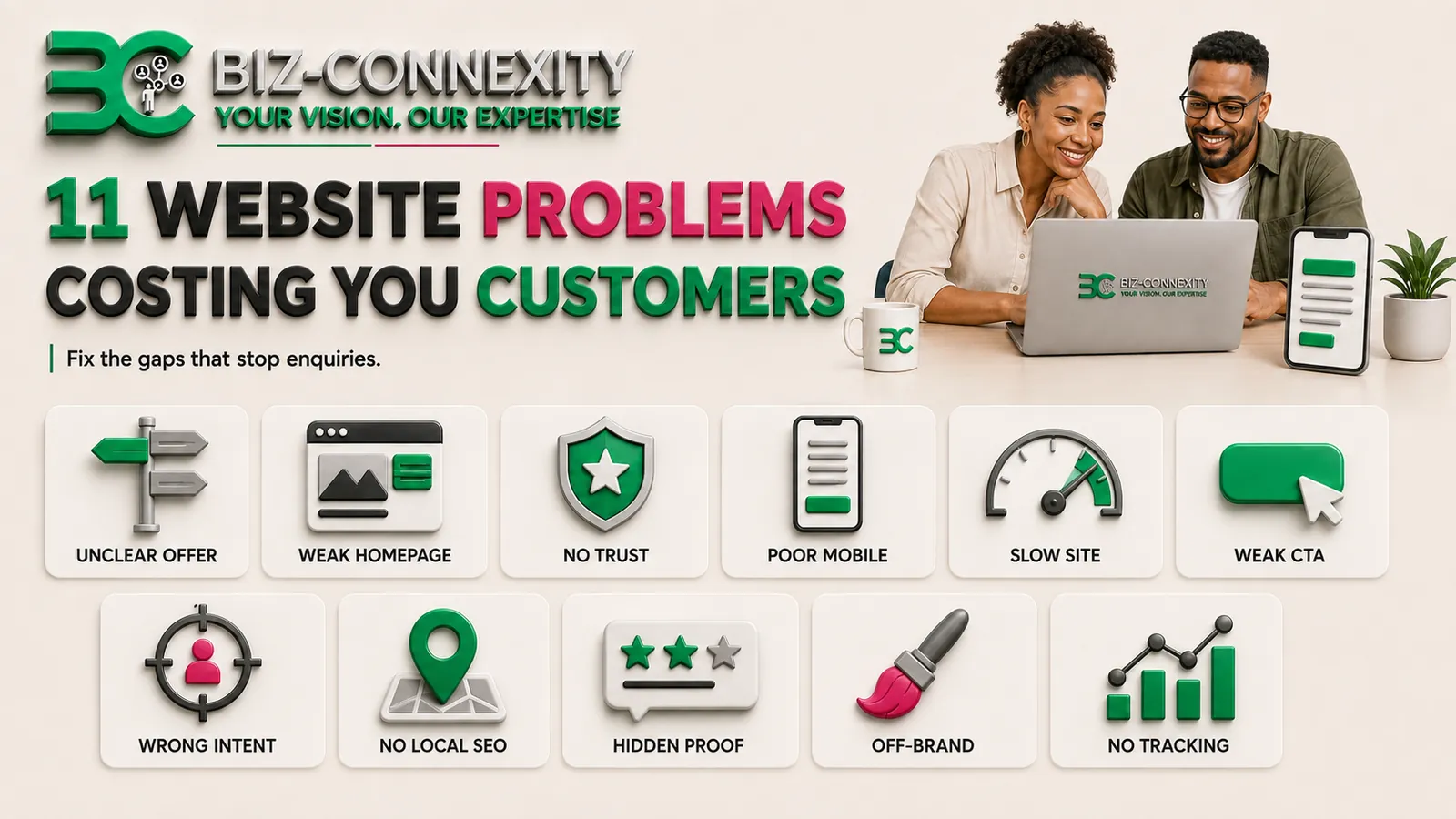
1. Nobody can tell what you actually do
The most common fault by a distance. The homepage opens with "Welcome to our website" or a slogan about excellence and passion, and a visitor still cannot say what the business sells. Vagueness feels safe to the owner because it excludes nobody. To a stranger it reads as uncertainty.

Fix it: put one plain sentence at the top of the page in the format what you do, who for, where. "Shopfront signage and vehicle branding for businesses across Cape Town and the Cape Flats" tells a stranger everything they need in nine seconds. Say it in the words customers use, not the words your industry uses. Our website design work starts with this sentence before a single layout is drawn, for the same reason brand positioning does.
2. The site is slow, especially on a phone
Owners test their own site on office fibre and conclude it is fine. Their customers open it on a mid-range Android on prepaid data in Khayelitsha or Kraaifontein, and wait. The usual culprit is a homepage carrying five photographs straight off a camera at several megabytes each.

Fix it: test your real pages in PageSpeed Insights on the mobile tab, then work the list. Compress and resize images to the size they are displayed at, serve modern formats, lazy-load anything below the fold, and remove plugins and tracking scripts you are not using. Google's page experience and Core Web Vitals guidance explains which measurements matter and why.
3. It was never really designed for mobile
Responsive is not the same as usable. A layout can technically resize and still leave body text at ten pixels, buttons two millimetres apart, a table that scrolls sideways and a menu that needs three taps to reveal the phone number.
Fix it: open your own site on your own phone and try to get a quote from it in under a minute. Fix what annoyed you. Body text at sixteen pixels or more, tap targets around forty-four pixels with space between them, no horizontal scrolling, and the phone number tappable in the header.
4. There are no trust signals
A stranger deciding whether to hand over money to a small business is looking for evidence that you exist, that you have done this before, and that other people survived the experience. Stock photographs of models in a boardroom in another country do the opposite.

Fix it: add real photographs of your work, your team and your premises. Show named testimonials rather than "great service, J.S.". Publish your physical area, your registration number, your years trading and any accreditations. Make sure the site runs over HTTPS. For business-to-business and public-sector buyers, add the compliance evidence they will ask for anyway, which is where CSD, B-BBEE and SARS readiness and a proper company profile earn their keep.
5. Contacting you is harder than it should be
We regularly find sites where the only route to a human is a contact form that has been silently failing for months, or a Gmail address in an image so it cannot be tapped. Every extra step between intent and contact costs you enquiries.
Fix it: give people at least three routes: a tappable phone number in the header, an email address as text, and a short form. Test the form yourself once a month from a phone. Keep the fields to what you genuinely need, and remember that collecting personal information brings obligations under POPIA, which is why our own forms carry a consent statement and a link to the privacy policy.
6. There is no clear next step
Some sites explain the business beautifully and then stop. The visitor is convinced, scrolls to the bottom, finds nothing to do, and leaves. Others do the reverse and offer nine competing buttons, which is the same problem wearing a different coat.
Fix it: decide the one action you want from each page, usually request a quote or call now, and make that the visually dominant element. Repeat it at the top, middle and end of long pages. Say what happens next: "send the details and we will come back within one working day" converts better than "submit".
7. The copy talks about you instead of the customer
Pages that open with the founding story, the mission statement and a list of internal processes are answering questions nobody asked. The visitor has a problem and is checking whether you solve it.
Fix it: read the last twenty enquiries you received and write the page using those sentences. Lead with the outcome, then the proof, then the process. "Installed overnight so you trade the next morning" does more work than "we offer comprehensive end-to-end solutions". This is the same discipline covered in our article on what makes a brand people trust.
8. Everything sits on one page
A single long homepage listing eight services cannot rank for any of them and cannot answer any of them properly. Someone searching for shopfront signage in Bellville needs a page about shopfront signage, not a paragraph inside a page about everything.
Fix it: give each service its own page with its own heading, its own proof and its own enquiry route. Link them sensibly from the navigation and from each other. That is why our own site separates shopfront signage, vehicle branding and car wraps and printing and signage rather than pooling them.
9. The site never says where you operate
Local intent is enormous in South African SME search, and a site that never names a suburb, city or service radius gives search engines and humans nothing to match. Owners leave it out because they will travel anywhere, then wonder why nobody local calls.

Fix it: name your areas in plain text on the relevant pages, keep your name, address and phone details identical everywhere, and complete your Google Business Profile with real photographs and accurate hours. Build genuine local pages where you have real depth, as we did for Mitchells Plain and the Cape Flats, and list the rest on a locations hub. The ongoing side of this is SEO and local visibility.
10. Nothing has been updated since launch
Copyright 2019 in the footer, a news page with one post, prices that are no longer true and a team page listing someone who left. Each one is small. Together they tell a visitor the business may not still be trading.
Fix it: pick a monthly half hour. Update the footer year, add two recent job photographs, refresh one testimonial, check every link and check the form still arrives. If you are publishing content, make it genuinely useful rather than filler, which is exactly what Google's helpful content guidance asks for.
11. Nobody is measuring anything
Without analytics you are redesigning on opinion. You cannot tell whether the problem is fifty visitors or five hundred, whether they leave on the homepage or the pricing page, or whether last month's change helped.
Fix it: install analytics, connect Google Search Console, and count enquiries per hundred visitors as your one headline number. Record where each real enquiry says it came from, even if that means asking on the phone. Then change one thing at a time. Broader measurement across channels is part of digital marketing and social media work rather than a website job on its own.
Brochure site vs a website that works
Both cost money to build. Only one of them returns any. The difference is rarely budget, it is a set of decisions taken at the start.
| Element | Brochure site | Website that works |
|---|---|---|
| Headline | Welcome to our website | What you do, who for, where |
| Structure | One page for everything | A page per service, each answering one intent |
| Speed | Full-size camera images | Compressed, sized and lazy-loaded |
| Mobile | Technically responsive | Designed and tested on a phone |
| Proof | Claims of quality | Photographs, named testimonials, credentials |
| Contact | One form, never tested | Tappable phone, email and a short tested form |
| Local | No areas mentioned | Named suburbs, matching profile and listings |
| Content | Untouched since launch | Updated monthly, questions answered |
| Measurement | None | Analytics, Search Console, enquiries counted |
A 15-point website diagnostic
Score one point for each statement that is true today. Check it on your phone, not your desktop, and be strict.
- 01A stranger can say what you sell within five seconds of landing.
- 02The page names the areas or cities you serve.
- 03Your phone number is visible and tappable without scrolling.
- 04The homepage loads in a few seconds on mobile data.
- 05Body text is comfortable to read without zooming.
- 06Buttons are large enough and far enough apart to tap accurately.
- 07There is no horizontal scrolling on any page.
- 08Every service you sell has its own page.
- 09Real photographs of your work appear on the site.
- 10At least three named testimonials or reviews are visible.
- 11The site runs over HTTPS with no browser warnings.
- 12Your contact form has been tested from a phone this month.
- 13The form states what happens next and how quickly.
- 14Analytics and Search Console are installed and being looked at.
- 15Something on the site has been updated in the last 90 days.
Reading your score
13 to 15: the site is working, invest in visibility. 9 to 12: you are losing enquiries to details, not design. 5 to 8: fix clarity, speed and contact before spending on advertising. 0 to 4: the site is costing you customers, start with the first four points. This is a practical diagnostic, not a certification or an official standard.
What to fix first, in order
Sequence matters, because the cheap fixes act on people who are already visiting and the expensive ones take months to show. Work down this list and stop when enquiries move.
- Week one: rewrite the homepage headline and make the phone number tappable.
- Week one: test the contact form and fix it if it is silently failing.
- Week two: compress images and remove unused scripts and plugins.
- Week two: add three real photographs and three named testimonials.
- Week three: split your biggest service off onto its own page.
- Week three: name your service areas and complete your Google Business Profile.
- Week four: install analytics and Search Console, and set your baseline.
- Month two onward: content, local pages and search visibility work.
If cash rather than clarity is the constraint on all of this, sort the sequencing out first through growth and funding readiness, and read our companion piece on the SME funding readiness gap before you commit to a spend.
How to tell it is actually working
Rankings are not the goal and neither is traffic. The number that matters is enquiries, and the number that explains it is enquiries per hundred visitors. Write down today's figure before you change anything.
- Enquiries per hundred visitors, measured monthly and compared to your own baseline.
- Calls and form submissions counted separately, because they behave differently.
- Mobile versus desktop conversion, which usually exposes phone-specific faults.
- Which page the enquiry started on, so you know what to build more of.
- Search Console impressions and clicks for the queries you care about.
Change one thing at a time and give it a fortnight. If you change five things at once and enquiries rise, you have learned nothing you can repeat. Where the picture is still unclear, an independent growth audit is faster than guessing, and more of our thinking sits in the Bizconnexity Insights hub.
How Bizconnexity helps South African SMEs
We work with owner-run businesses across South Africa, from Cape Town, Bellville and Mitchells Plain to Gqeberha, Durban and Johannesburg, and we start by finding out which of the five steps is failing rather than selling a rebuild by default.
- Diagnosis: where visitors leave, and whether it is a traffic or a conversion problem.
- Copy and structure: a clear offer, one page per service, one obvious next step.
- Build and repair: fast, mobile-first sites, or fixes to the site you already have.
- Proof: photography, testimonials and case material presented properly.
- Local visibility: Google Business Profile, service areas and local search.
- Measurement: analytics, Search Console and a monthly enquiry number you can trust.
No guaranteed rankings and no invented benchmarks. We will tell you which of the eleven problems is actually costing you enquiries, and what it takes to fix it.
Frequently asked questions
Almost always because one of five things is missing: clarity about what you sell, relevance to what the visitor searched for, trust signals, ease of contacting you, or a clear next action. Traffic problems and conversion problems look identical from the outside, so check your analytics before you rebuild anything.
There is no universal benchmark, and any agency quoting one for your industry is guessing. What matters is your own baseline: measure enquiries per hundred visitors this month, fix one thing, and compare. A site that was converting nobody and now converts somebody is the only proof that counts.
Fast enough on a mid-range phone on mobile data, not on your office fibre. Google's Core Web Vitals guidance gives measurable thresholds, and PageSpeed Insights will test your real pages. Large unoptimised images are the most common single cause of a slow South African SME site.
Most sites we look at need fixes, not a rebuild. Rebuild when the platform is unmaintainable, the site is not mobile responsive at all, or it cannot be edited without a developer. Otherwise clarity, speed, proof and contact routes can usually be fixed on the existing site for far less.
Decisive. Most SME traffic in South Africa arrives on a phone, frequently on prepaid data. If your text is small, your buttons are hard to tap, or your pages are heavy, you are losing the majority of your audience before they read anything.
Not for its own sake. Content earns its place when it answers questions buyers actually ask before they choose. Three genuinely useful pages beat thirty thin ones, and Google's helpful content guidance is explicit that content written for people rather than rankings is what holds up.
Usually local signals rather than design: a complete Google Business Profile, reviews, consistent name, address and phone details, and pages that name the areas they serve. Design influences whether people enquire; local signals influence whether they ever see you.
Conversion fixes such as clearer copy, a visible phone number or a working form can change results within days because they affect people already visiting. Visibility work through search usually takes weeks to months, because it depends on crawling, indexing and competition.
A builder is fine for a small brochure site if you will keep it current. Have one built when you need speed, structured content, integrations or a site that must sell against established competitors. The wrong question is which tool; the right one is who maintains it after launch.
The homepage does not say plainly what the business does, who it is for and where it operates. It is the cheapest fault to fix and the most expensive to leave.
Where this connects next
Editorial note
This article is written and maintained by the Bizconnexity team from website work with South African SMEs. The Visibility-to-Enquiry Gap and the diagnostic below are practical Bizconnexity frameworks, not official standards. Performance and search guidance is summarised from the cited sources, and we review the article when that guidance changes. Nothing here is legal advice.
Related articles
- Branding & Business GrowthYour Logo Is Not Your Brand: 9 Things South African SMEs Need to Build a Brand People TrustA logo is one small part of a brand. Here are the nine elements South African SMEs need to close the Credibility Gap and build the trust that wins better customers.Read the article →
- SME Funding & DevelopmentSouth Africa's SME Funding Paradox: 9 Ways to Close the Gap Between a Good Business and a Fundable OneOnly about 5% of formal South African MSMEs access credit, while SMEs carry roughly 34% of output and 60% of jobs. Here is what the Funding Readiness Gap is, and nine practical ways to close it.Read the article →
About the author
David Gous
Founder, Bizconnexity
David Gous is the founder of Bizconnexity, where he focuses on helping South African SMEs solve practical business challenges across strategy, compliance, branding, digital growth and funding readiness.
Primary sources reviewed
How this article was researched
- Google Search Central, Core Web Vitals and page experienceHow loading, interactivity and layout stability affect the experience search systems assess.
- Google PageSpeed InsightsFree tool for testing the real-world speed of your own pages on mobile and desktop.
- Google Search Central, creating helpful contentWhat search systems look for in useful, people-first business content.
- Google Business Profile HelpHow your business information, photos and reviews appear in Search and Maps.
- Information Regulator South Africa, POPIASouth African requirements for collecting and processing personal information through forms.
Last evidence review: 1 September 2026. Funding requirements change between providers and over time, so verify current eligibility, cost and application requirements directly with the relevant institution.